

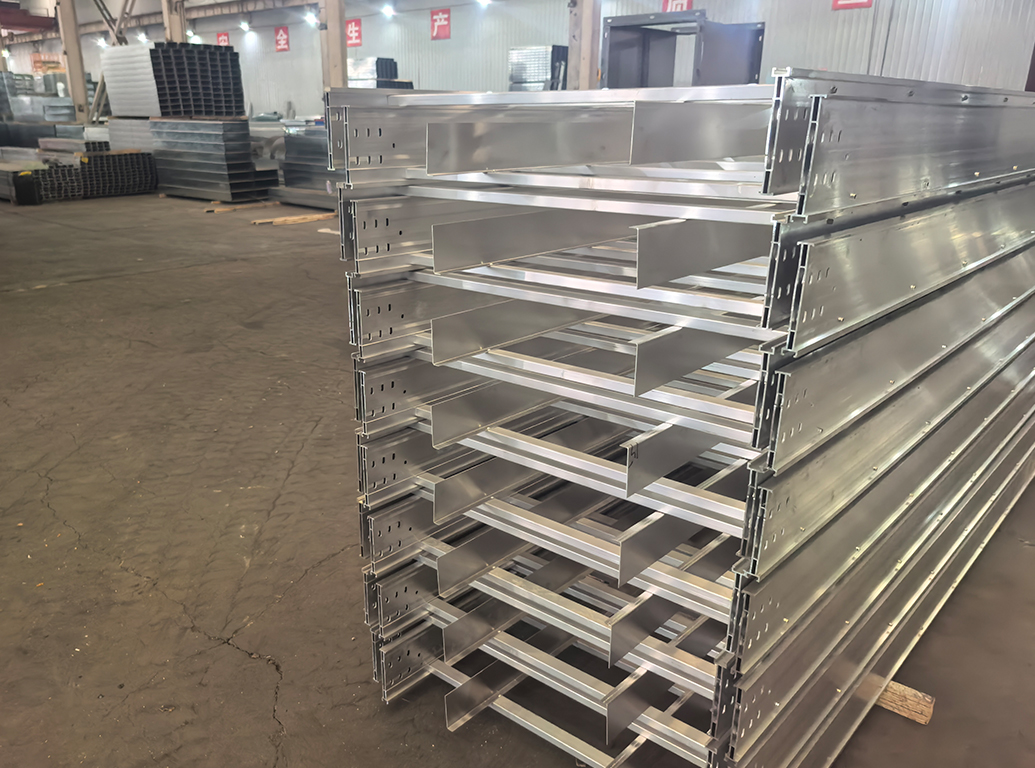
Trough cable trays are one of the most widely used cable management solutions in industrial, commercial, and infrastructure projects.
Designed to provide structured support, protection, and organization for electrical and communication cables, trough cable trays are valued for their
durability, stable load-bearing capacity, and clean routing performance. In modern power distribution, data transmission, automation systems, and building
installations, the demand for reliable cable tray systems continues to grow as projects become larger, more complex, and more compliance-driven.
This page provides a general, industry-focused introduction to the production process and quality control of trough cable trays. It is written in
SEO-friendly English for use in blog articles, category pages, industry landing pages, and directory content. The information below does not promote
any specific company or brand. Instead, it explains the common manufacturing workflow, material selection, surface treatment options, dimensional
specifications, performance advantages, inspection procedures, and application scenarios associated with trough cable trays.
If you are looking for a clear overview of trough cable tray production, quality control methods, structural features, and technical considerations,
the following sections offer a structured reference that can help support search engine visibility while also serving as practical industry content.
A trough cable tray is a metal cable support system with a solid or nearly solid bottom and side rails that form a channel-like structure.
Compared with Ladder cable trays or wire mesh trays, trough cable trays offer stronger protection for cables against dust, light impact, and partial
interference from external environmental factors. Their semi-enclosed design makes them suitable for environments that require orderly cable routing,
moderate shielding, and dependable mechanical support.
Trough cable trays are commonly manufactured from galvanized steel, stainless steel, aluminum, or other corrosion-resistant metals depending on the
installation environment. They are widely used in electrical engineering, industrial plants, data centers, commercial buildings, transportation systems,
utility facilities, and machinery installations. Because they combine functional protection with relatively easy installation, trough cable trays are often
selected for projects that require an efficient and scalable cable management system.
The main purpose of a trough cable tray is to organize and protect cables while improving system accessibility and installation efficiency. In general,
trough cable trays offer the following functions:
The popularity of trough cable trays is closely linked to their balance of protection, accessibility, and cost efficiency. Many engineers and project planners
prefer them because they help standardize cable routing while reducing installation complexity. In comparison with fully enclosed conduits, trough cable trays
generally allow faster cable placement, easier inspection, and simpler future maintenance. In comparison with Open cable trays, they provide a more stable
trough structure that helps limit cable movement and offers better side protection.
Another important advantage is adaptability. Trough cable trays can be manufactured in multiple widths, heights, thicknesses, and finishes to suit different
load conditions and environmental requirements. This flexibility makes them a common choice across low-voltage, medium-scale industrial, and commercial wiring systems.
Material selection is one of the most important steps in trough cable tray manufacturing because it directly influences strength, corrosion resistance,
service life, and appearance. The most common materials include:
| Material | Main Features | Typical Applications | Advantages |
|---|---|---|---|
| Pre-galvanized Steel | Economical, good formability, common indoor use | Commercial buildings, general electrical projects | Cost-effective, easy to process, widely available |
| Hot-Dip Galvanized Steel | Thick zinc coating, stronger corrosion resistance | Industrial plants, outdoor installations | Longer service life, better weather resistance |
| Stainless Steel | High corrosion resistance, clean appearance | Food facilities, chemical areas, marine environments | Excellent durability, suitable for harsh conditions |
| Aluminum | Lightweight, naturally corrosion resistant | Data centers, lightweight structures | Easy handling, low weight, corrosion resistance |
| Powder-Coated Steel | Decorative finish with added surface protection | Indoor architecture, visible cable routes | Good appearance, improved surface protection |
The production of trough cable trays typically follows a controlled manufacturing sequence that ensures structural consistency, dimensional accuracy,
and surface quality. Although specific factory procedures may vary, the general production process usually includes the following stages.
The process begins with the selection of raw metal sheet or coil. Material quality is critical because it affects the tray’s load-bearing strength,
weldability, corrosion resistance, and final appearance. Manufacturers generally check thickness tolerance, flatness, coating condition, chemical composition,
and surface defects before production begins. Any material with excessive rust, scratches, deformation, or coating damage may be rejected or reprocessed.
Once approved, the metal material is cut into the required size according to the production plan. Cutting may be performed by shearing, slitting, laser cutting,
or stamping depending on factory equipment and product design. Accurate cutting is important to ensure that the finished trough cable trays match the
required width, length, and connection dimensions. Proper cutting also helps reduce material waste and improves manufacturing efficiency.
If the design requires mounting holes, ventilation slots, joint openings, or accessory connection points, the tray body is punched or perforated during this stage.
Hole positions must remain accurate so that installation parts, supports, brackets, and connectors can fit properly on-site. In some designs, punching is also
used to assist in cable tie fixing, drainage, or heat dissipation.
The flat metal sheet is then shaped into the trough profile using forming machines or press brakes. This step creates the side rails and bottom channel that define
the tray structure. Bending accuracy directly affects the tray’s strength, alignment, and assembly precision. A stable forming process ensures that the tray
retains consistent dimensions and can connect smoothly with adjacent sections.
Some trough cable tray designs require welding at corners, joints, reinforcements, or support points. Welding quality is critical because weak or uneven welds can
reduce load capacity and shorten product life. During fabrication, weld beads should be smooth, firm, and free from cracks, excessive spatter, or undercutting.
Depending on the product design, mechanical joining may also be used in certain sections.
Surface treatment improves appearance and enhances resistance to corrosion, wear, and environmental damage. Common surface treatment methods include:
The choice of treatment depends on the working environment, required durability, and project budget. For outdoor or high-humidity locations, a stronger
anti-corrosion finish is typically preferred.
After cutting, punching, forming, and welding, sharp edges, burrs, and surface residues must be removed. Cleaning and deburring are essential for safe handling,
better coating adhesion, and improved visual quality. Smooth edges also reduce the risk of cable insulation damage during installation and long-term use.
Trough cable trays are often supplied with connectors, couplers, brackets, covers, fasteners, clamps, and support accessories. During final assembly, all parts
should be checked for dimensional consistency and compatibility. When products are shipped as separate sections, packaging should protect edges and coatings from
transport damage.
Finished products are usually bundled, wrapped, or palletized for shipping. Proper packaging helps prevent coating scratches, deformation, and moisture damage.
For export or long-distance transport, moisture-proof wrapping, corner protection, and labeled stacking are commonly used to preserve product quality.
Quality control is essential in trough cable tray manufacturing because these products must perform reliably in demanding electrical and structural environments.
A well-designed quality control system helps ensure that each tray meets the intended load capacity, dimensional accuracy, surface finish, and corrosion protection
requirements. The following are common quality control checkpoints.
Incoming raw materials should be inspected for thickness consistency, surface defects, zinc coating quality, mechanical properties, and general compliance with
project specifications. Material traceability is also important, especially in projects that require certified metal grades or documented batch control.
Dimensional accuracy is one of the most critical aspects of trough cable tray quality control. Inspectors typically verify tray width, height, wall thickness, length,
bend angle, hole spacing, and connector fit. If dimensions are out of tolerance, installation may become difficult or unsafe.
The surface of the cable tray should be smooth, uniform, and free from major defects such as peeling coating, rust spots, scratches, dents, blisters, or exposed metal.
For coated products, coating thickness and adhesion may also be tested to confirm surface protection performance.
Welding points and structural joints should be examined for stability and appearance. Poor weld quality may cause structural weakness or failure during loading.
Visual inspection, weld seam checking, and in some cases mechanical testing are used to assess joint reliability.
Trough cable trays must support the weight of installed cables over specific spans. Load-bearing tests help verify that the tray can handle expected working loads
without excessive deflection, deformation, or structural damage. This is especially important in industrial facilities, long-span installations, and heavy cable routes.
Because cable trays are often used in humid, outdoor, or chemically exposed environments, corrosion resistance testing may be required. Depending on the product
type, salt spray testing, coating evaluation, or environmental exposure simulation may be used to assess long-term protection performance.
The tray body must align correctly with connectors, supports, bends, reducers, and accessories. Fit testing ensures that installation is smooth and that the system
remains mechanically stable after assembly. This is particularly important for modular cable management projects.
The following table summarizes common inspection items used in trough cable tray quality control:
| Inspection Item | Purpose | Common Method |
|---|---|---|
| Material Thickness | Confirm structural strength and compliance | Caliper or thickness gauge |
| Tray Dimensions | Ensure installation accuracy | Measuring tools and templates |
| Surface Finish | Check coating and appearance quality | Visual inspection and coating gauge |
| Edge Smoothness | Prevent cable damage and handling injury | Manual and visual inspection |
| Weld Integrity | Confirm structural reliability | Visual inspection and load verification |
| Load Capacity | Confirm support performance | Static load test |
| Corrosion Protection | Evaluate service life in harsh conditions | Coating check or salt spray test |
| Accessory Compatibility | Ensure easy system assembly | Trial fit test |
Trough cable trays are available in a variety of specifications to support different installation requirements. The exact dimensions may vary by region,
design standard, and project demand, but the following table shows commonly used industry ranges.
| Specification | Common Range | Notes |
|---|---|---|
| Width | 50 mm to 1000 mm | Selected based on cable volume and future expansion needs |
| Height | 25 mm to 150 mm | Affects cable containment and structural stiffness |
| Length | 2000 mm to 3000 mm | Standard lengths may vary by manufacturer |
| Thickness | 0.8 mm to 3.0 mm | Depends on load requirements and material type |
| Material | Steel, stainless steel, aluminum | Chosen according to environment and budget |
| Surface Finish | Galvanized, powder-coated, polished | Provides corrosion resistance and appearance control |
| Load Rating | Light to heavy duty | Defined by design and span conditions |
Trough cable trays are widely selected because they deliver a strong combination of technical and installation advantages. Their main benefits include:
To better understand trough cable trays, it is useful to compare them with other common cable tray systems. While each design serves a different purpose,
trough trays are often seen as a balanced solution between openness and protection.
| Tray Type | Main Structure | Protection Level | Typical Use |
|---|---|---|---|
| Trough Cable Tray | Channel-like tray with side rails and solid or semi-solid bottom | Medium to high | General electrical and industrial cable management |
| Ladder Cable Tray | Rung-style open structure | Lower | Heavy cable loads and maximum ventilation |
| Wire Mesh Tray | Basket-style mesh structure | Medium | Lightweight and flexible indoor routing |
| Solid Bottom Tray | Fully closed or nearly closed bottom design | High | Areas needing extra cable shielding |
Trough cable trays are suitable for a wide range of industries and project types. Common applications include:
Several factors can affect the final quality of a trough cable tray. Understanding these factors helps buyers, engineers, and project planners choose products
that fit the intended use environment.
When evaluating a trough cable tray product, it is important to look beyond appearance and focus on technical details. A reliable product should have
consistent dimensions, smooth edges, stable coating quality, proper load capacity, and well-finished joints. Documentation may also include material certificates,
test reports, and installation instructions. These elements help confirm that the product is suitable for practical engineering use.
In SEO-focused industry content, it is also important to highlight intent-based keywords such as trough cable tray manufacturing, cable tray production process,
cable tray quality control, Galvanized cable tray, Steel cable tray, and cable management system. These terms help search engines understand the topical relevance
of the content and support better indexing for industrial search queries.
Although this article focuses on production and quality control, installation performance is closely related to product design. During project planning,
the following considerations are often important:
Trough cable trays require relatively low maintenance, but periodic inspection can help extend service life. Routine checks may include confirming that
fasteners remain tight, surfaces remain free from severe corrosion, and cable loads have not exceeded design limits. In facilities with harsh conditions,
more frequent inspection may be necessary to maintain safety and performance.
Good manufacturing quality combined with suitable surface protection can significantly improve long-term reliability. For this reason, quality control
in the production process is not only a factory issue but also an important factor in lifecycle performance.
The following keyword phrases are naturally relevant to this topic and can support search engine optimization when used appropriately in titles, headings,
image alt text, and body content:
Trough cable trays remain an essential part of modern cable management because they combine practical protection, structural reliability, and installation
efficiency. Their production process typically includes material selection, cutting, punching, forming, welding, surface treatment, and final inspection,
while quality control focuses on dimensions, load performance, coating integrity, and assembly fit. When produced with consistent standards, trough cable trays
can deliver dependable service across a broad range of industrial and commercial applications.
For SEO-driven industry content, a clear structure, relevant technical terminology, descriptive headings, and useful specification tables can help improve
indexing performance and user engagement. Whether used in a blog post, category introduction, or industry knowledge page, the information above provides a
strong foundation for explaining trough cable tray production and quality assurance in an original, search-friendly format.
```


Copyright © 2026 Hebei Xinnin Metal Products Co., Ltd
SitemapThis website uses cookies to ensure you get the best experience on our website.
 Español
 한국어
 العربية
 ไทย



 Phone
Comment
(0)